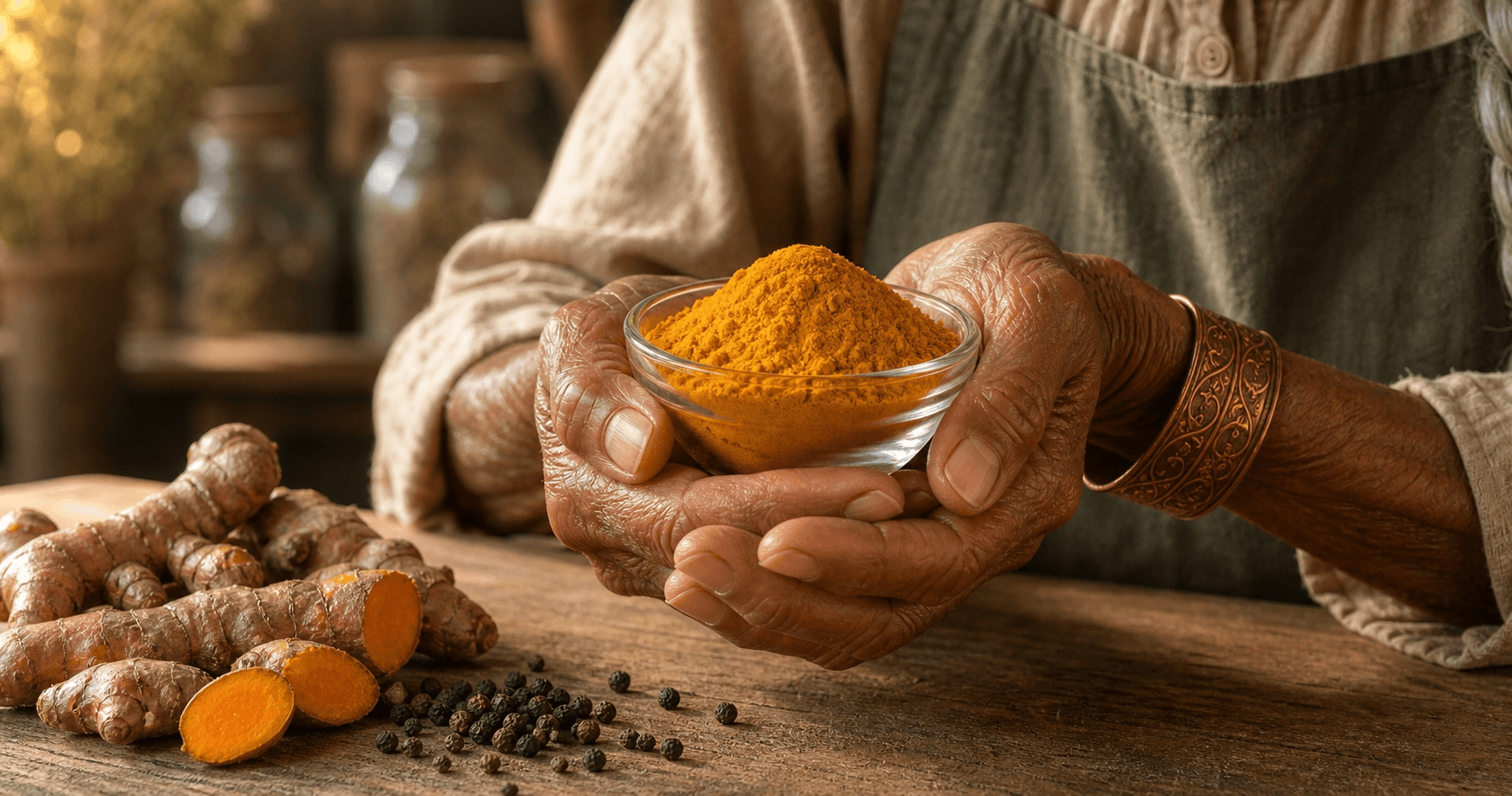
Turmeric for Joint Pain — Does It Really Work?
Stiff, aching joints stealing your mornings? Granny Dovie explains how turmeric works, the correct dose, and the best supplement for real results.
Does your body feel like it belongs to someone twice your age?
You wake up and your knees remind you they were there first. Your hips ache before your feet hit the floor. You reach for something on a shelf and your shoulder fires back with a warning. Honey, that is not getting older. That is inflammation — and it has been stealing your mornings for far too long.
What if one root — one golden spice sitting in kitchens for thousands of years — could turn that around?
Granny Dovie has kept turmeric in her cabinet for over forty years. Not as a garnish. Not as a pretty color in a curry pot. As medicine. The kind the Good Lord grew up out of the ground for folks who needed it.
This post walks you through everything you need to know about turmeric for joint pain. What it does, how it works, how to take it, and which supplement delivers the true benefit your joints need.
What Does Turmeric Do for Joint Pain?
Turmeric grows as a root. It comes from the same plant family as ginger. Healers in Ayurvedic and Chinese medicine have relied on it for over 4,000 years — the same tradition that understood immunity long before modern science gave it a name. Turmeric carries an active ingredient called curcumin — and curcumin does the heavy lifting for your joints.
When your joints ache, the root cause in the majority of cases is inflammation. Your body sends signals to damaged tissue. Those signals cause swelling, stiffness, and pain. Curcumin blocks the pathway that triggers inflammation — a molecule called NF-kB that drives long-term inflammation deep in joint tissue.
A 2016 study in the Journal of Medicinal Food found that curcumin matched ibuprofen for knee joint disease pain. It did this without the stomach damage that comes with long-term NSAID use. That is not a small finding, honey. That is science catching up to what grandmothers already knew.
How Turmeric Reduces Joint Inflammation
A lining called the synovium wraps around every joint in your body. When that lining becomes inflamed it thickens and fills with fluid. That fluid causes the stiffness and swelling you feel every morning.
Curcumin targets that inflammation at the source. It slows the inflammation chemicals your body sends during a flare. It also shuts down COX-2 enzymes — the same targets that ibuprofen and aspirin go after. Curcumin does this without the stomach problems that come with daily NSAID use.
A 2019 large review study in Frontiers in Pharmacology reviewed 8 clinical studies. It found that curcumin produced a measurable reduction in joint pain scores and mobility scores compared to a sugar pill. The majority of participants showed measurable improvement within 4 to 8 weeks of daily use.
Turmeric does not mask pain the way a pill does. It works beneath the surface — calming the fire that causes the pain in the first place.
Turmeric for Knee Joint Pain
Knee pain drives the majority of people to search for turmeric remedies online. The knee carries more load than any other joint in the body. It takes the greatest punishment from years of standing, walking, and climbing stairs.
A 2021 study in Trials followed 70 adults with knee joint disease over 12 weeks. Half received curcumin and half received a sugar pill. The curcumin group reported a 58% reduction in pain scores. They also showed a strong improvement in walking distance and stair-climbing ability.
The researchers concluded that curcumin delivered safe and effective results for managing knee joint disease symptoms. The treatment group reported no serious adverse effects.
If your knees have been holding you back, honey, this is the remedy worth taking seriously. The earth grew it for you. All you have to do is take it.
“He makes grass grow for the cattle, and plants for people to cultivate — bringing forth food from the earth.”
— Psalm 104:14
Does Turmeric Help Joint Pain and Inflammation Together?
Yes — and that separates it from a great deal of pain remedies.
The majority of over-the-counter pain relievers address the symptom. They quiet the pain signal without addressing the underlying inflammation. When you stop taking them the pain returns — often worse — because the inflammation never resolved.
Turmeric works differently. Curcumin addresses both pain and inflammation together. It lowers inflammation markers in the blood — including CRP and IL-6. It also reduces pain sensitivity in swollen tissue.
A 2015 study in Phytotherapy Research measured CRP levels in adults with joint inflammation disease. Researchers measured before and after 8 weeks of taking curcumin. CRP levels dropped by 52% in the curcumin group compared to 10% in the control group. Curcumin reduced the inflammation itself — not the sensation of pain.
This remedy has always been about deep healing. Not covering up the problem. Addressing it at the root.
Turmeric and Ginger for Joint Pain — A Powerful Combination
Turmeric delivers strong results on its own. But pair it with ginger and you have a remedy that covers two different inflammation pathways at once.
Ginger carries ingredients called gingerols and shogaols. Both fight inflammation hard. They work through a different pathway than curcumin. Curcumin targets the NF-kB and COX-2 pathway at its core. Ginger blocks inflammation chemicals through a separate pathway. Together they cover more ground than either one alone.
A 2015 study in Arthritis found that a combination of ginger and curcumin reduced knee pain scores by 63% over 6 weeks. Curcumin alone produced 47%. Ginger alone produced 38%. The combination produced results that neither ingredient could achieve on its own.
Granny Dovie's golden milk recipe — turmeric, ginger, black pepper, and raw honey in warm milk — delivers both of these roots together in one cup. This remedy works while it warms you from the inside out.
How to Take Turmeric for Joint Pain
Here is where a great many people go wrong, honey. They sprinkle turmeric on their food and wonder why it does not work. Absorption determines how much curcumin your body takes in — and turmeric powder on food delivers without question little.
The digestive tract absorbs curcumin poorly on its own. Without the correct delivery method, the majority of curcumin passes straight through your body. It never reaches your joints. Three remedies increase absorption by a measurable margin.
Black pepper: Black pepper carries an active ingredient called piperine. Piperine increases curcumin absorption by up to 2,000% according to a study in Planta Medica. This is why every quality turmeric supplement includes black pepper extract.
Fat: Curcumin dissolves in fat. It absorbs better when taken with a meal that contains healthy fat — such as olive oil, coconut oil, or avocado.
Heat: Warming turmeric in liquid increases absorption compared to taking it cold or dry.
A high-quality turmeric supplement with black pepper extract taken daily with a meal delivers far more benefit than turmeric powder sprinkled on food.
How Much Turmeric to Take for Joint Pain
The correct dose gives curcumin the strength it needs to reduce inflammation at the joint level. Too little and you will not see results.
Every study that showed true results for joint pain used between 500mg and 1,500mg of curcumin per day. Practitioners split that amount into two or three doses. The majority of quality supplements deliver 500mg per capsule. A twice-daily regimen keeps things simple and consistent.
For maintenance — keeping joints comfortable and inflammation low — 500mg once or twice daily gives your body what it needs. During a flare-up, clinical practitioners use 1,000mg to 1,500mg daily. Always take it with food and black pepper extract.
One critical note: turmeric supplements do not equal turmeric spice. Turmeric spice contains only 2 to 5% curcumin by weight. A quality supplement standardizes the curcumin content to 95%. That delivers a strength that food cannot match.
How Long Does Turmeric Take to Work for Joint Pain?
Granny Dovie hears this question in the majority of conversations. The answer depends on how consistent you are.
Turmeric does not work the way ibuprofen does. Ibuprofen floods your system fast and fades in four hours. Turmeric builds up over time. It reduces baseline inflammation in a steady way.
The majority of people report noticeable improvement within 2 to 4 weeks of taking it daily. Full benefit — reduced stiffness, improved range of motion, and lower pain scores — comes at 6 to 8 weeks of consistent use.
Consistency drives the results. Missing days breaks the accumulation effect. Think of it the way you think of watering a garden — one good watering does not grow the plant. The daily habit produces the harvest.
Turmeric for Joint Pain and Stiffness — Morning Stiffness Relief
Morning stiffness ranks among the most severe symptoms of joint inflammation. You wake up and your body needs 20 or 30 minutes to loosen up. Inflammatory fluid builds up in the joint capsule overnight when the body rests. That fluid causes the stiffness you feel every morning.
Curcumin reduces morning stiffness by lowering joint lining inflammation. With lower baseline inflammation, less fluid builds up overnight. The joint wakes up closer to its true range of motion.
A 2017 study in Oncotarget found that daily curcumin reduced joint lining inflammation by 41% over 8 weeks. Participants reported 35% less morning stiffness.
Take your turmeric supplement in the evening — with dinner and a fat-containing meal. That timing allows curcumin to work through the night when joint inflammation peaks.
The Best Turmeric Supplement for Joint Pain
The supplement market floods shelves with products that use low-quality turmeric powder with minimal curcumin content and no absorption enhancers. You can spend money on those products for years and wonder why your joints never improve.
Granny Dovie trusts Garden of Life Turmeric for joint pain. Here is why it earns that trust.
Certified organic — no pesticides, no fillers, no synthetic additives.
Standardized to 95% curcuminoids — the same strength every major study has used to produce results.
Includes black pepper extract — for the 2,000% absorption increase that makes curcumin work.
Whole food based formula — the way the Good Lord grew it, not a synthetic extraction.
Non-GMO verified and third-party tested — so you know without question what you are putting in your body.
Garden of Life has earned the trust of natural health practitioners. A third party has verified it for label accuracy. The curcumin content on the label matches what is in truth inside the capsule.
Granny Dovie Recommends
Garden of Life Turmeric
Certified organic turmeric standardized to 95% curcuminoids with black pepper extract for maximum absorption. Non-GMO, whole food based, third-party tested.
Turmeric vs Glucosamine for Joint Pain
A great many people with joint pain take glucosamine. It supports cartilage structure. Joint health practitioners have relied on it for decades. How does turmeric compare?
Glucosamine works structurally. It provides building blocks that support cartilage repair over time. Turmeric works differently. It reduces the inflammation that damages cartilage and causes pain. They address different aspects of joint health.
Research without question favors curcumin over glucosamine for pain relief. A 2014 study found that curcumin reduced pain scores by 58% compared to 29% for glucosamine over 8 weeks. For structural support, glucosamine has value. But for the pain and inflammation you feel today, turmeric delivers superior results.
The ideal approach for people with measurable joint breakdown combines both — turmeric for inflammation and pain, glucosamine for structural support. But if you choose one, turmeric addresses the immediate problem that affects your daily life.
Turmeric Gummies and Shots for Joint Pain — Do They Work?
The supplement market has pushed turmeric into gummies, shots, teas, and drinks. These products look convenient and appealing. But do they deliver enough curcumin to produce joint pain relief?
The honest answer — the majority do not.
Turmeric gummies contain 50mg to 100mg of turmeric powder per serving. Research-backed dosages begin at 500mg of curcumin. A gummy with 100mg of turmeric powder holds only about 3mg of true curcumin. That falls far below what your joints need.
Turmeric shots deliver higher strength, but the majority lack the black pepper extract that makes curcumin absorbable. Without piperine, even a high-dose turmeric shot delivers a fraction of what a properly made supplement delivers.
A capsule supplement with black pepper extract remains the reliable delivery method for true joint pain relief. Save the turmeric tea and golden milk for enjoyment and mild daily support. Rely on a quality supplement for the full benefit.
Does Turmeric Cause Joint Pain?
This question appears often enough that it deserves a straight answer.
In a rare number of cases — people with oxalate sensitivity — high doses of turmeric have triggered increased joint discomfort. Turmeric carries a higher oxalate load than the majority of roots. People prone to kidney stones or with trouble processing oxalates may feel discomfort at high doses.
For the vast majority of people, turmeric relieves joint pain — it does not cause it. The studies reviewed above show pain reduction — not pain increase — in populations taking the correct dose of curcumin.
If you begin taking turmeric and notice increased joint discomfort, stop taking it and consult your healthcare provider. Beginning at a lower dose — 250mg once daily — and building up over two weeks allows your body to adjust. That approach helps identify any sensitivity before it becomes a true concern.
Safety and Who Should Be Cautious
Thousands of years of use and dozens of modern clinical trials confirm turmeric's safety profile for the vast majority of adults. Certain groups require caution.
If you take blood thinners such as warfarin, talk to your doctor before taking curcumin. Turmeric carries mild blood-thinning properties that can interact with those medications.
People scheduled for surgery should stop taking turmeric at least two weeks beforehand. Blood-thinning properties make that pause necessary.
If gallbladder disease or a blocked bile tube affects you, avoid high-dose curcumin. It stimulates bile production and can make those conditions worse.
Pregnant women should limit turmeric to food-level amounts. Avoid concentrated curcumin supplements without medical guidance.
An extensive body of safety research confirms that turmeric at 500mg to 1,500mg daily causes no adverse effects in the vast majority of healthy adults with no existing conditions.
“A cheerful heart is good medicine, but a crushed spirit dries up the bones.”
— Proverbs 17:22
Granny Dovie's Golden Milk Recipe for Joint Pain
Granny Dovie has made this recipe at her kitchen table for decades. It combines turmeric, ginger, black pepper, and raw honey in warm milk. It delivers curcumin, gingerols, and piperine together in one warming cup.
Ingredients: 1 cup whole milk or unsweetened coconut milk 1 tsp turmeric powder 1/2 tsp fresh grated ginger or 1/4 tsp ginger powder A pinch of black pepper 1 tsp raw honey added after cooling Optional: 1/4 tsp cinnamon
Instructions: Step 1 — Warm the milk in a small saucepan over low heat. Do not boil. Step 2 — Whisk in turmeric, ginger, black pepper, and cinnamon. Step 3 — Simmer on low for 5 minutes, stirring as needed. Step 4 — Remove from heat and let cool for 2 minutes. Step 5 — Stir in raw honey. Step 6 — Pour into your favorite mug and drink in small sips.
Drink one cup each evening before bed. The fat in the milk increases curcumin absorption. The black pepper activates the curcumin. The honey adds its own anti-inflammatory properties. Old wisdom in a warm cup, honey.
🌿
Not Sure Which Remedy Is Right for You?
Answer five simple questions and Granny Dovie will point you to the right remedy for your body, honey.
Take Granny Dovie's Remedy Finder Quiz →When Your Joints Need More Than a Root
Frequently Asked Questions
Does turmeric help with joint pain?
Yes. Multiple clinical studies confirm that curcumin — the active ingredient in turmeric — reduces joint pain and inflammation in conditions such as joint disease and joint inflammation disease. A 2016 study found curcumin matched ibuprofen for knee joint disease pain without the stomach problems that come with long-term NSAID use.
How long does turmeric take to work for joint pain?
The majority of people report noticeable improvement within 2 to 4 weeks of taking it daily. Full benefit arrives at 6 to 8 weeks of consistent use. Consistency drives the results — missing days breaks the accumulation effect.
How much turmeric should I take for joint pain?
Research-backed dosages range from 500mg to 1,500mg of curcumin per day, taken with food and black pepper extract. The majority of people begin with 500mg twice daily and adjust based on their response.
Is turmeric better than ibuprofen for joint pain?
For long-term daily use, turmeric delivers a safer result than ibuprofen. Curcumin addresses inflammation at the source without the stomach damage, heart risk, and kidney strain that come with long-term NSAID use. For sudden pain relief within the first hour, ibuprofen acts more rapidly. But turmeric produces deeper and longer-lasting results over time.
Can I take turmeric every day for joint pain?
Yes. Taking turmeric daily at the correct dose delivers safe results for the vast majority of healthy adults. The clinical trials showing the strongest results used daily use over 8 to 12 weeks. Always take it with food to reduce any chance of stomach sensitivity.
What is the best turmeric supplement for joint pain?
Look for a supplement standardized to 95% curcuminoids with black pepper extract included. Garden of Life Turmeric meets both criteria — certified organic, non-GMO, and third-party tested for label accuracy.
Does turmeric help knee joint pain in particular?
Yes. The majority of joint pain clinical trials focused on knee joint disease and found curcumin effective. A 2021 study found a 58% reduction in knee pain scores after 12 weeks. Participants showed strong improvements in walking distance and stair-climbing ability.
Can turmeric cause joint pain?
In rare cases involving oxalate sensitivity, high-dose turmeric may trigger increased joint discomfort. For the vast majority of people, turmeric relieves — not causes — joint pain. If you notice increased discomfort after beginning, reduce the dose and consult your healthcare provider.
Granny Dovie Recommends
Garden of Life Turmeric
Certified organic turmeric standardized to 95% curcuminoids with black pepper extract for maximum absorption. Non-GMO, whole food based, third-party tested. The only turmeric supplement Granny Dovie trusts for joint pain.
🎁
Get Granny Dovie's 15 Secret Remedies — Free
A free guide with fifteen of Granny Dovie's most trusted remedies. Straight from the old ways, child. No charge.
Send Me the Free Guide →This post contains affiliate links. If you purchase through a link on this page, we may earn a small commission at no extra cost to you.
When the Old Ways Need a Little Backup
Granny Dovie's remedies have worked for decades. But honey, sometimes your body needs something stronger. For those days when the old ways need a little backup — this is what I recommend.
Learn More About This Product